From Game to Cinematic: A Look Back at Our FX Work on War Robot: Frontiers
Retrospective
February 12, 2026 - Budapest
Originally released nearly a year ago, the War Robot: Frontiers Cinematic Release Date Trailer marked an important moment for us at Ionart. With some distance from the original release, this retrospective offers an opportunity to revisit the work and share how the effects were built, from large-scale battlefield destruction to fine-detail character integration.
As real-time engines and cinematic pipelines continue to converge, the challenge is no longer just about scale, but about translation. Game-native assets and in-engine effects are built for speed and interactivity. Cinematic storytelling operates with a different emphasis on enhanced visual fidelity and detail.
For the War Robot: Frontiers Cinematic Release Date Trailer, we translated in-game reference into cinematic effects while preserving the game’s visual identity.
This breakdown offers a behind-the-scenes look at how we approached the large-scale battlefield effects, explosions, shockwaves, and atmospheric interaction, rebuilding motion and energy through Houdini and compositing to meet cinematic requirements.
Building a Cinematic Battlefield
While the War Robot: Frontiers world originated in a real-time environment, the cinematic sequences required a different approach. In-game reference established the look and feel, while the cinematic versions were reconstructed in Houdini and finished in compositing to integrate lighting, depth, and environmental interaction.
Explosion and Combat FX
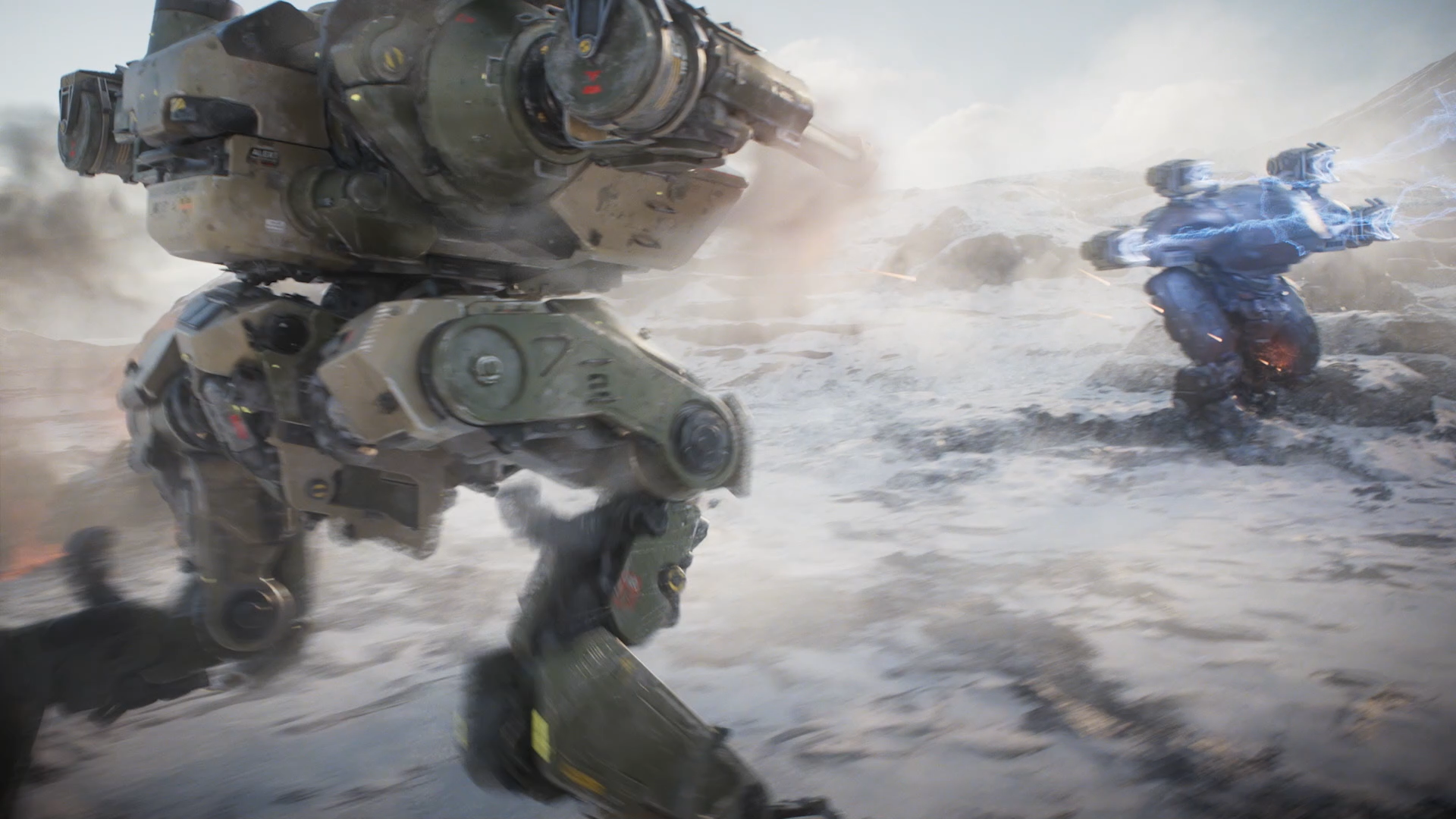
For the battlefield opening, our FX team generated a large-scale explosion composed of three core simulations: the rocket trail, the main blast, and debris-driven smoke.
The primary detonation was built with frame-accurate precision. A custom particle solver controlled the blast’s velocity, turbulence, and falloff, while VDB-based shield interactions were layered in compositing to enhance the sense of volumetric depth and lighting response.
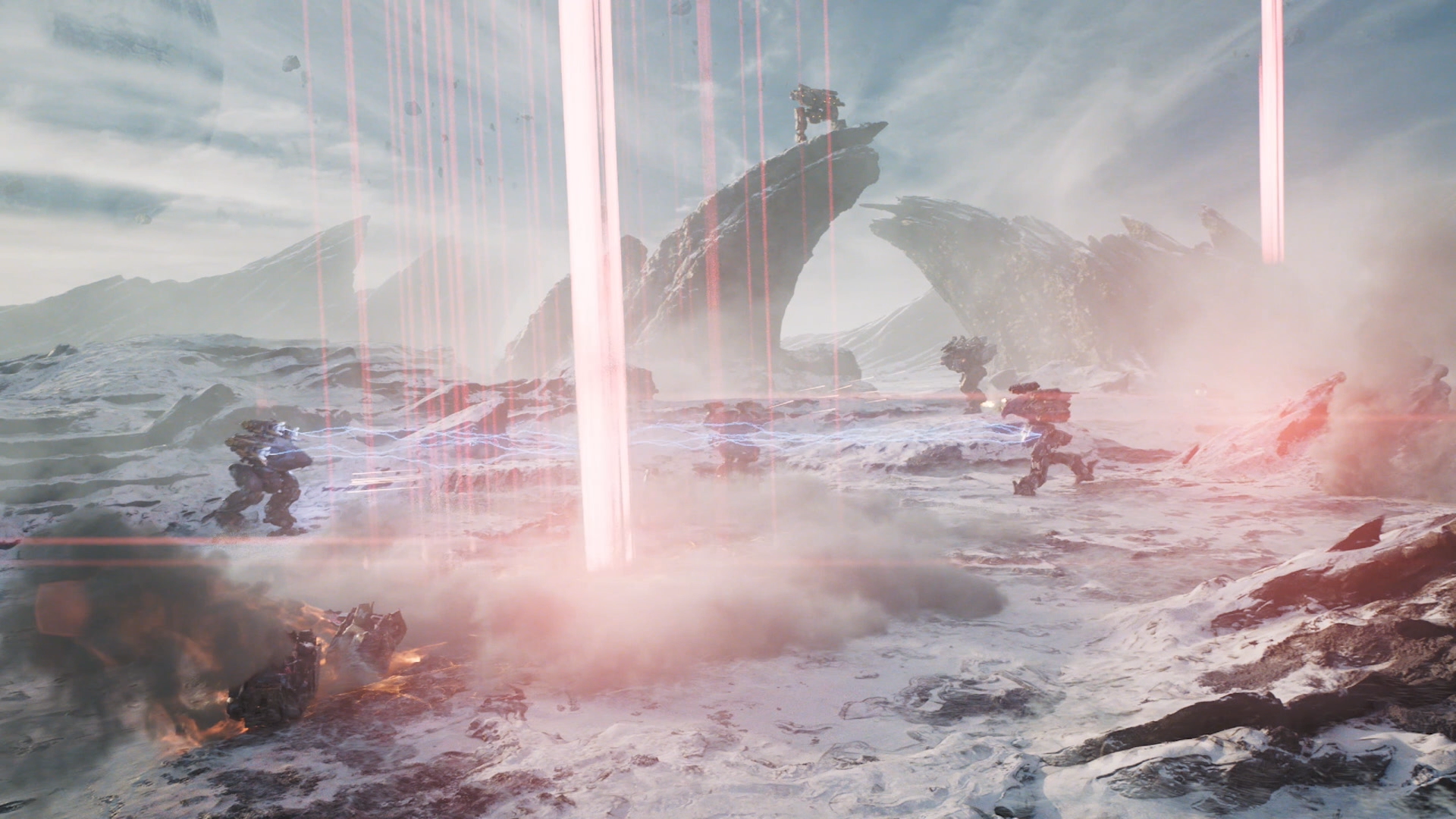
A defining visual in the combat sequence was the sky-beam effect. Built using multi-layered particle systems and a custom vector-based motion blur solution, the effect maintained a strong sense of energy without incurring excessive render cost.
Ground shockwaves were driven by adaptive velocity fields to naturally contain their propagation and preserve readability within the frame. Proprietary Houdini tools allowed our artists to paint snow, wind, and secondary debris directly onto the terrain, grounding the action within the battlefield.
Procedural smoke simulations and VDB caches were composited to reinforce atmosphere and depth across shots.
Character Integration and Fine-Detail FX
As the sequence transitions from large-scale combat to more character-driven moments, our FX work shifted accordingly. Hair-groom dynamics, cloth simulations, and subtle particulate effects were applied to integrate the human lead into a physically consistent environment.
These fine-detail simulations ensured that character performance remained grounded within the same physical space as the surrounding destruction, maintaining continuity between spectacle and story.

A Layered Approach to Cinematic FX
From macro-scale explosions to fine-detail simulations, each FX layer was designed to interact seamlessly with the others. The result was a physically consistent and visually cohesive world built specifically for a high-energy cinematic trailer.
Rather than simply scaling up real-time effects, we focused on translating game-native visuals into a cinematic context, extending the intent and visual language of the game through shot-based design and layered simulations.
While the cinematic itself was released earlier, the project reached a new internal milestone late last year. The War Robot: Frontiers Cinematic Release Date Trailer became the first Ionart project we formally submitted for consideration to the Visual Effects Society Awards.
While recognition is never guaranteed, the submission process served as an important benchmark for craft, scope, and presentation. It gave us a clear opportunity to evaluate how our simulation work stands alongside industry peers and helped inform how we approach future cinematic and effects-driven projects.